Showing posts with label Norge. Show all posts

Sunday, March 3, 2019

Films & Thoughts @ Oslo's International Documentary Film Festival

Inspired into Action?

This week Oslo has been hosting the International Documentary Film Festival with the theme Human Rights & Wrongs. All week there have been a number of different film screenings, debates, talks, and art events. Unfortunately, I had a final exam so I missed a lot. On the bright side, there is still a lot going on this weekend, including tomorrow on the final day of the festival.

Film festival program.

I've never been to a film festival before, so it was really a nice experience! Not to mention the tickets for students were very reasonable and the venue (Vega Scene) was great. I'm hoping tomorrow to go to a couple of the lectures as well. I highly recommend going to the film fest or checking out some near you; documentaries can be really interesting! 

There really was a great variety of films with many different themes. See here for full event program. Today, I watched two documentaries, Anote's Ark and Grit.

First one in the theater; excited to see Anoke's Ark.

Anote's Ark was about former president of Kiribati, Anote Tong's journey of trying to fight to ensure his people will be taken care in the face of catastrophe caused by climate change.  What catastrophe exactly am I talking about? 

Program description for Anote's Ark.

Kiribati (pronounced Kiri-bas) is a series of islands located in a unique part of the Pacific Ocean, situated right along the equator, and in both the Northern and Southern Hemispheres. Historically, the region never had any storms, but with changing weather patterns has been pummeled by hurricanes, and tropical storms which have flooded villages, destroyed homes, ruined fresh water sources and agricultural lands. Even without the storms, the islands face a far worse fate. By the end of the century, the nation will be completely underwater due to rising sea levels. Where will the people go? Will they be able to preserve their culture and traditions? It's not a matter of if the islands will be swallowed by the sea, it's when, and which other nations will follow thereafter.

The story followed a Kiribati family making the move to New Zealand to start a new life, and also showed the president's journey to protect his nation's future. During the Paris talks of 2015, President Tong was instrumental in making sure large countries like the US would pay to help islands adapt. It wasn't a matter of 1.5 C or 2 C degrees, because climate change was already coming to conquer Kiribati. The president bought some land in New Zealand for his people to move to when they become climate refugees. Yet, there are still many questions. What kind of life would the people have in New Zealand? Do they need visas? What jobs could they do there?

Inside Vega Scene theater.

Refugees are forced to flee their homelands because they have no other choice. The islanders don't want to move. They don't want to lose their motherland, their lives, their histories. But there is no other option. Kiribati's story is not the only one that will end this way. Climate change, global warming, call it what you like. It is happening. It is everywhere. Maybe your home won't be swallowed by the seas, but the heat will grow, the rains will pound, or you will see other adverse effects.

The saddest part of the story is that the innocent people and countries, those who contribute least, pay the most.  Kiribati is just the first of many places which will meet the same fate from climate change. We must all work to do our best by consuming less, and ensuring opportunities for all to have a bright green future. Planet over profit, always. 

Anoke's Ark was a sad film, but an inspiring one too. It's easy to feel hopeless from all of the negativity, but sometimes you need to use it to channel change, and propel yourself into action. The movie was also quite touching, because before the film began there was a clip Anoke recorded specifically for us at the festival, to motivate, especially the younger generation to take charge of the future, and work to set things right. The film also won the honorable mention for the festival's Human Rights, Human Wrongs Film Award. Watch the trailer and learn more here.

Screen tonight after the showing of Grit.


The other film I saw today was Grit, which chronicled a young girl whose family's village was wiped out from the Sidoarjo mud flows in Indonesia. As the girl goes through middle and high school, she starts to be an activist in her community, and decides she wants to become a lawyer to fight for environmental justice. The film highlights the burdens placed on many communities, and the all too common injustice caused by rich companies' environmental negligence. 

Description of Grit from the program.

It all started in 2006, when the natural gas company Lapindo, carelessly drilled down too far into the earth, striking a mud pocket. A mud volcano exploded, burying sixteen villages. The mud continues to pour out every day, even though it's been thirteen years since the explosion. Today, the Sidoarjo mud flow continues to rise, despite also continuously draining into the local rivers.

The only thing preventing the mud from reaching more villages are levies, which are being built higher and higher as the mud continues to flow. The levies are just another disaster waiting to happen. Furthermore, there is speculation that the mud and fumes from the volcano are toxic, because people have died from cancer after working there, and there have been massive fish die offs in the rivers. Following the disaster, the government deliberately cut off studies of the mud from the area, so the health dangers remain a mystery, threatening those who are forced to work on the mudflats.

Event posters inside of Vega Scene.

Following the disaster was poverty and problems for the locals, who had to fight for over nine years to ever get any sort of compensation. Justice still isn't served. Lapindo has started to drill again, the mud continues to flow, and corruption continues to buy free passes for powerful companies.

It was my first time hearing about the mud volcano in Indonesia, so I found the film very interesting. However, at the same time I was also very angry about the greed and injustice. Too often those with money take advantage of others; hurting people and the planet in greedy pursuit. Overall, interesting movie, and I hope Indonesian activists will continue to fight to protect their communities. You can check out the trailer and learn more here.

Festival posters inside Vega Scene.

Thank you to the Human film festival for bringing global problems closer to home, teaching me about the injustices, & inspiring me to want to fight to make things right!

Friday, February 15, 2019

Ice Sculptures in the Evening

Lysvandring i Botanisk hage

Plants alight in the botanical gardens.

First of all, sorry I haven't posted anything in quite awhile; I've been very busy with studies, an internship, and working on several proposals. I'll try to post more things in the coming weeks. That being said, I hope everyone's 2019 is off to a great start! 

Semi circle of ice sculptures.

Valentine's day isn't a big thing in Norway. Really it felt like a normal day, until the occasional man carrying flowers reminded me it wasn't just a typical Thursday.

Ice sculptures.

Rather than going on a fancy date, or being spoiled with flowers and chocolates; I enjoyed a quick trip down to the natural history museum's botanical gardens for an evening of lights and science.

Lights, colors, ice.

In coordination with the 2019 European Green Capital festivities happening in Oslo, the botanical garden hosted a display of carved ice sculptures, lights, and educational activities. 

View of the ice sculptures.

Throughout the gardens there were stands relating to health, anatomy, insects, and climate; offering visitors the chance to view the museum collections and learn something during their nighttime stroll.

Frozen 'virus' sculptures.

Unfortunately, I didn't have too much time to spend checking out the stands, because I needed to get home to finish an application. So, I mostly came to enjoy the ice sculptures.

Bright blue ice virus.

Lysvandring i Botanisk hage (light walk in the botanical garden) did not disappoint. I enjoyed getting to see the different light displays, and even saw a stand with self playing guitars.

Ice sculpture of a virus.

My favorite part of the evening was looking at the ice sculptures all lit up. The theme for the sculptures this year was viruses, which explains the variety of different abstract shapes.

Glowing virus sculpture.

Fortunately, yesterday was much warmer than earlier this winter (3-5 degrees C; hot compared to the typical negative temps), making for a pleasant walk. The only problem with the heat is that the snow melts, making the paths much more slippery. Luckily even with the dim lighting I managed to stay on my feet.

Ice sculpture.

Overall, it was another lovely night in Oslo. Tusen takk!

Monday, December 31, 2018

Sunset over the Sea

Sunset over Oslofjord: painting the winter sky

Sunset at Oslo Harbor

As 2018 draws to a close, it's time for the sun to set and for the final lines to be written for 2018. Just as the sunset casts reflections in the ripples of Oslofjord, I'm going to use this last blog post of the year for reflection, and to just share some of my favorite photos from Oslo.

Sunset over the boats at Aker Brygge.

One year ago, I could only dream of living in Oslo. Now after several months, full of wonder, and sometimes struggles, I'm so blessed to be able to call this city my home.

View of the boats and Akershus Festning.

In the short time I've been here, I have absolutely fallen in love with the nature; islands, parks, forests, and lakes around the city.

Boats in the harbor.

I'm so grateful for my parents who have always supported me, and continue to have my back despite the distance. I am also grateful of my classmates, friends, and Norway for welcoming me with open arms and helping me to feel at home.

Statues along Oslo harbor.

Despite the challenges I've faced and those which will surely arise next year, I feel so blessed and happy. This next year; dream big, work hard, and never give up! Anything is possible if you believe!

The setting sun.

Thanks for taking time out to read my blog! I look forward to sharing new adventures and photos! Wishing everyone a safe, happy, and healthy 2019!

Godt nytt år!   Hyvää Uuta Vuotta!   Happy New Year!

Ships & Sightseeing

Viking Ships, a Fortress, Palace & Lots of Snow 

Gokstad Viking Ship.

Two weeks ago I had the pleasure of hosting some family from Finland for a weekend trip in Oslo. I had such a great time getting to play tour guide and show them the city. One of the places we went to was the University of Oslo's (UiO) Viking Ship museum in Bygdøy.

Gokstad Viking Ship.

In addition to three authentic viking ships on display, there are lots of different artifacts, and a brief film showing what life was like for the vikings. The Gokstad ship on display dates back to the year 900 AD and was the final resting place of an important man. Despite being plundered, the ship still had some tools, a board game, small boats, a sleigh, and the remains of different animals offerings.

Oseberg Viking Ship.

The Oseberg ship was built around 820 AD and used in 834 AD to bury two powerful women. The grave had several sleighs, intricately carved posts, and sacrificed animals. The museum also hosts the Tune ship from 900 AD, and other grave goods and riches.  Despite being a rather small museum, it is a nice to visit if you are interested in learning about vikings, plus a visit to UiO's Historical Museum is also included in the price of admission.

The Oslo Opera House (Operahuset).

Just across from Oslo Sentralstasjon (Oslo S or Central Station), the world famous Operahuset sits along the fjord's shore. Completed in 2007, the opera house is iconic for it's exterior sloping roofs, which visitors can climb up and sit outside on. Even during the wintertime visitors can scale the building to take in the views, but it can be quite slippery so be careful if you choose to do so. 

Shirt art project outside of SALT.

Across from the opera house is the large Nordic sauna known as SALT. The main sauna seats approximately 100 people, and hosts different events and evening activities. Outside of SALT there is currently an art installation with t-shirts from Norwegians and Finns hanging in the "Arctic Pyramid" which is a triangular tunnel made from traditional fish racks. 

View of the fortress.

A short walk along the harbor from SALT and past the Norwegian Armed Forces Museum (Forsvarsmuseet), one can glimpse Akershus Fortress rising in the distance.

View of the fortress' South Wing.

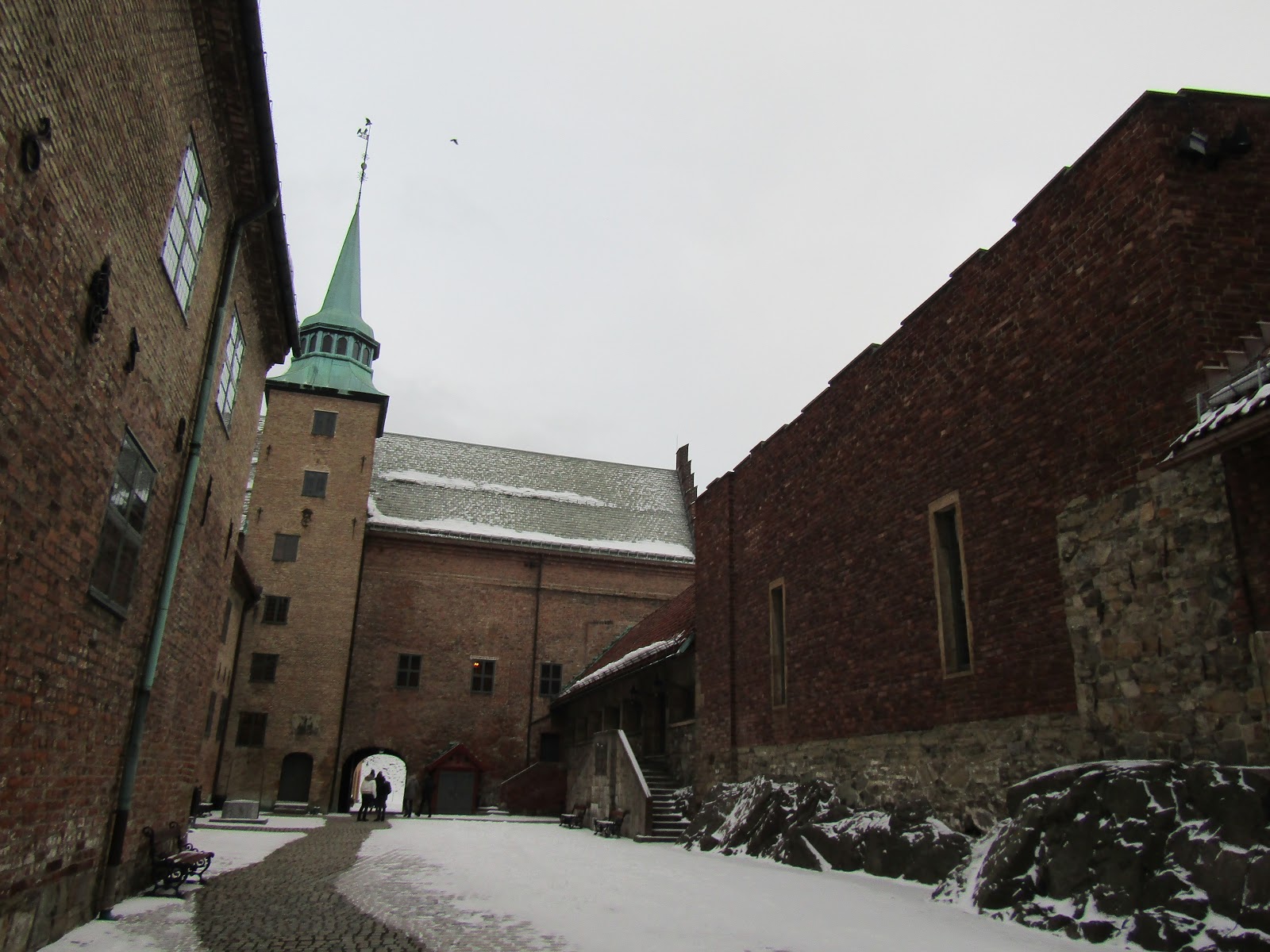
Akershus Festning or Akershus Fortress dates back to the medieval ages with the first construction of the fortress beginning around 1290 AD. By the early 1300s, the fortress faced it's first defense against invading Swedish forces.

Cannons in front of Munk's Tower.

Over the years, the fortress has undergone a lot of changes, from creating new entrances and military reinforcements, to remodeling and modernizing the castle's interior. The fortress has also served many purposes ranging from being the king's residency, to a prison, military post, and a royal mausoleum and house for the crown jewels; thereby cementing its role as an important cultural site. 

View of the fortress chapel and inside courtyard.

The fortress grounds are open till 21:00 everyday and free to walk around. There is also a free museum displaying artifacts and detailing the history of the grounds. A fixture to Oslo harbor and one of the few places where you can find free public toilets (which can be important when you're out and about), I've been to the fortress quite a lot since I've lived in Oslo. However, it was the first time I actually got to go inside the castle courtyard. Normally, the doors are sealed with a guard patrolling outside.  On this particular day, the gates were open for a church service taking place in the chapel, offering us the chance to take a peak inside.

The North Wing from the inner courtyard.

From the courtyard one can glimpse the chapel built in the 1500s, and the South, Chancery, and North Wings. The South Wing host's the original castle entrance from the 1300s which can still be seen in what is known as the "dark passage." Today, the South Wing serves as the reception room for the castle, meanwhile the North Wing holds the castle's cellar, and several elaborate halls including the Lady's Hall and Royal Hall. Historically, the Chancery Wing held the castle's lavatories, whereas beginning in 1648, the North Wing has been the castle's main entrance. 

Portion of the Royal Bastion.

Today, visitors can marvel at and take photos of actual servicemen and women from the king's royal guard who patrol the ramparts and castle gate. The armed forces continue to have a presence on and around the fortress in the nearby military base, school, and museums.

Snow covered Norwegian Resistance Museum.

During WWII, the fortress was occupied by the Nazis and the grounds were used to execute Norwegian's from the resistance. Since 1949, there is a memorial near the Resistance Museum for those who lost their lives there. Beginning in 1652, the fortress also became a prison used to house and rent out thieves and criminals to do hard labor around the city. Finally in 1950, the prison closed after several centuries of housing criminals.

View of the fortress' frozen pond.

Following a fire which destroyed Oslo, the current city foundations emerged around the fortress in 1624. Not only is Akershus Festning central to Oslo, but being steeped in over 700 years of history, it serves as an important cultural and historical site for all of Norway. 

Rådhus (Oslo City Hall).

Just down the street from the fortress lies Rådhus, or Oslo's City Hall. Visiting a city hall may seem a little unconventional, but I highly recommend heading inside for a look around. Finished in 1950, the city hall is enormous and boasts many large murals, paintings, sculptures, and a hall displaying the gifts given to the city of Oslo over the years. In addition to making sure things are running smoothly in Oslo, city hall also hosts the presentation of the Nobel Peace prize each December. 

Christmas tree and CO2 display at Universitetsplassen. 

Across from national theatre lies the University of Oslo's Universitetplassen, or University Square surrounded by three of UiO's law faculty buildings. Each December, a giant Christmas tree is lit on the square. This year the 1 Tonn of CO2 earth balloon was raised on the square during Oslo's Peace Week earlier this December, to correspond with the awarding of the Nobel Peace Prize. Furthermore, Oslo is the 2019 European Green Capital!

Slottet (the Royal Palace).

A short trek up from Universitetplassen lies Slottet or Det kongelige slott (the royal palace). Built in the 1800s, the palace overlooks Karl Johans gate which is one of the main streets in Oslo. During summer, visitors can marvel in the gardens or take a tour of the palace. Beginning in autumn, the royal family moves back into the palace for the winter months, as signaled by the red flag that flies high above the palace when the king is home. One can still walk up to the palace, watch the changing of the guards, and explore slottsparken (the palace park) which remains open in the northern and eastern sides of the palace year-round.

View of Karl Johans gate (street) from Slottet.

During December Oslo boasts many different Christmas markets. The largest one is the Julemarked (Christmas market) located at Spikersuppa park just down the hill adjacent to Karl Johans gate. The market offers lots of food, Norwegian products, and also rides and an ice skating rink. The market at Spikersuppa is pretty commercialized and very crowded during the weekends, but is nice to stop for a snack. Throughout the city, there are many other Christmas markets that remain up all month, in addition to weekly artisan markets; providing many opportunities to soak up the holiday cheer.

Carolers at the Prindsen hagen julemarked.

On the last day my family was visiting, we did a walking tour around the city going to all of the places mentioned above, minus the viking ship museum which we visited on the day before. We then ended our day at the Prindsen artisan Julemarked, and wrapped up by having waffles with traditional brown cheese and jam while we listened to carolers. It was an absolutely lovely day in Oslo.

Christmas tree in front of city hall. 

I love getting to play tour guide, so if anyone is in Oslo and looking for someone to show them around or recommend places to check out, please don't hesitate to ask!

Happy holidays! 

Sunday, December 30, 2018

Along the Frozen Lake

Snow, Ice and a Winter Wonderland

The winter bridge in Brekkedammen park.

Today the sun was shining and it was just a chilly -1˚C (30˚F), so no better time to get outside and take in the sunshine and beautiful snowy landscape.

View of Maridalsvannet.

I walked up along the Akerselva to Kjelsås, through Brekkedammen park, and around Maridalsvannet.

Maridalsvannet frozen lake.

The view of Maridalsvannet was absolutely stunning. Finally, the lake has frozen over, making it the perfect place to go ice skating.

View of the lake.

I had a nice walk through the forests, where now there are a couple of cross country ski paths too. Fortunately for me, there hasn't been much snow lately, so apart from being quite slippery in places, it was easy to walk the paths. Maybe later on in the season if there is a lot of snow, the trails will only be for cross country skiing.

Winter hiking adventure.

The nice thing about this time of year is that it is slowly starting to get lighter and lighter each day. By now the sun sets at 15:20pm which may still seem very early, but with the snow it doesn't feel too dark when you're outside.

Winter trails through Sander farmland.

Sundays are always so crowded in the city, so I enjoy trying to get out in nature away from the busy paths of the city center. The further I walked, the more trrails I had completely to myself which was nice.

Frozen plants.

The plants were lovely with the little spiky bits of ice and frost glinting in the sunlight.

Winter wonderland.

With the snow covered foliage, the land looked so beautiful and peaceful. 

Frozen landscape of Sander Gård.

The land was quiet apart from my boots hitting the frozen earth. In Norway they don't use salt on the roads, but rather have rocks, or nothing at all once you are out on the trails. It can be quite slippery at times, so it takes a bit to get used to the rhythm of having to walk on the ice.

Frozen river to Maridalsvannet.

Through one snowy farms and across the bridge to another. At this time of year even some of the rivers have frozen over, allowing people to ice skate up and down them.

Nes Gård.

All was quiet on the farm, as the hard work has been done until springtime. As I passed Sander Gård, I noticed two horses outside in the snow. They weren't moving at all, so I wondered if they were frozen. As I passed by, they moved slightly but remained mostly still just bathing in the sunlight. 

View of the lake from Nes Gård.

I had walked around Maridalsvannet once before back in November, but it was nice to get to see how everything now looked with the snow rather than the autumn leaves.

Sunset over the snowy countryside.

Besides taking in the fresh air and getting to explore new areas, one of the reasons I enjoy getting to go outside and walk around is that it gives me the chance to clear my mind, think things over, and get aware from the stresses of school and so forth. I absolutely love nature, so being outdoors is by far where I feel the happiest.

Sunset from the frozen lake.

I got so excited when I was up above hiking around the lake and noticed all of the ice skaters dancing down below. Because Maridalsvannet is the main drinking source for Oslo, there aren't many access points to that lakeside, so it took me quite awhile to actually get down to the ice.

Looking southwards over the frozen lake towards Kjelsås.

If you want easy access to the lakeside but don't feel like walking from Kjelsås through the forests, you can take bus #51 in the direction of Maridalen, and get off at the stop, Kirkeby, which is right after the ruins of St.Margaret's Church.

Footprints over the frozen lake.

Despite not having any ice skates, I didn't want to miss out on getting to experience the frozen lake so I braved the lake in my shoes. I just didn't have too much trouble walking, but just kind of shuffled along exploring the northern shore.

Sunset over Maridalsvannet.

The sunset over the lake was absolutely stunning and I just wanted to stay out all evening taking it in.

The thick ice near the lake shore.

In a couple of places the lake had some thick cracks in the ice where you could see the ice's thickness (at least a few inches in some sections). Even with these cracks, the ice was completely solid, minus some small areas along different sections of shoreline which were still liquid.

Sunset behind Margaretakirkeruinen.

As the sky was painted with rainbow colors, I basked in the beauty of Norway, of earth's natural wonders, and of life itself. With the last day of 2018 arriving tomorrow, I am reminded of how precious each and every day is. As this year comes to a close, I am grateful of all of the opportunities I have been granted this year, and I look for forward to exploring more and continuing to grow as a person come 2019.

Wishing everyone a safe, happy, and healthy new year full of many adventures!