Sunday, October 7, 2018

Gressholmen Island

An Autumn Island Adventure

 The ferry backing away from the Island.

Island hopping is an easy day-time adventure in Oslo. At the harbor, several Ruter boats leave periodically throughout the day ferrying visitors between the islands in Oslofjord. It's very convenient, because the same ticket or pass for transportation on the bus, metro, etc., works on the Ruter ferries too.

 Detail of the rocky island surface & pathways.

During the summertime many islands are accessible by ferry, but as the seasons change, the shops and cafes close down, and the ferries no longer go to every island. Before it get's any colder, I wanted to get out and take advantage of the beautiful weather and the colorful changing leaves.

Plants on Gressholmen. 

So today, I decided to catch the ferry to an island. By chance when I was walking up, the ferry to Gressholmen was about to leave, so rather than waiting in line to catch a boat to a different island, I got aboard this one.  The ride took about 20 minutes, and there was one prior stop to a nearby island before arriving at Gressholmen. The ferry comes back every hour, and on the way back to Oslo harbor makes three other stops at different islands where people can get on/off to hike around.

Black rocks and mussel shells littering the beach.

Gressholmen translates directly to "Grass Islet." Today the island is connected to Rambergøya meaning ''Raven Rock Island," and Heggholmen or "Hagberry Islet" (named for a Hagberry flower). Together, the three joined islands make up a nature preserve, with a unique variety of plants, animals, and terrain. 

Along the shore of Gressholmen. 

The ferry drops visitors off at Gressholmen, where there is a short hike through the forests to get down to the shore. During the summertime, there is also a cafe that's open with snacks and refreshments.

The changing leaves make the hillside look aflame. 

 The other two islands which are now connected to Gressholmen can be easily reached by dirt/rock paths. Just a side note, some trails are accessible for wheelchairs, but the majority of the island is very rocky and hard to get around if you can't walk.

Looking through the fields on Rambergøya. 

There are dozens of little trails running up along the sides of the island and along the shore. Fortunately, it wasn't windy, nor very crowded so it was easy to wander and explore the majority of the island in a couple of hours.

The rocky sides of Rambergøya. 

I didn't see many animals on the island, maybe just one or two birds the entire time. Otherwise, everything was very quiet, calm, & peaceful.

Narrow & rocky pathway leading up the hillside. 

Looking back on Rambergøya Island. 

Opposite side of Rambergøya. 

Beach on Rambergøya.

The nature really was lovely and diverse. It's surprising how different one side of the same island can look compared to the other.

Thousands of tiny shells alone the beach.

Gressholmen beach was covered mainly with mussels. Yet, despite being just a short distance away on the opposite side of the island, Rambergøya was primarily covered in tiny orange shells.

Boating around towards Heggholmen.

The island is a poplar place to go fishing, and many go kayaking or boating around in Oslofjord and stop by the different islands to rest and have a picnic.

Looking out over Oslofjord. 

 Gressholmen harbor.

Heggholmen is directly next to Gressholmen before you get to Rambergøya. However, I didn't end up going over there till after I had explored the other part because I thought it was a more residential area. In general, there are several cabins spread along the shore near Rambergøya and Heggholme, but not really on Gressholmen. 

View of the Gressholmen harbor from Heggholmen. 

Gressholmen is home to a small boatyard which was once an airport for seaplanes from 1927-1939.

View of Oslofjord from Heggholmen.  

Heggholmen's chapel. 

Also on the edge of Heggholmen is a wooden chapel looking out into Oslofjord.

Flower on Heggholmen. 

There were all sorts of different flowers on the islands of all different colors, shapes, and sizes.

Leaves changing colors on Gressholmen. 

Despite it being a bit chilly, I really enjoyed the getting to explore the island and see all of the different colored leaves. This is my favorite time of year, and I had a lovely visit to the island.

View of Lindøya Island from Gressholmen.

If you ever visit Oslo, I highly recommend taking a ferry around and getting off at the different islands. Each spot has its own unique nature and charm, and it is very easy to catch a ride on to the next island. I can't wait to visit them all!

Tuesday, October 2, 2018

Touristic Trondheim

Welcome to Trondheim, Norway!

Posing on the Gamble Bybro overlooking the Nidelva.

Situated in Trøndelag county, Trondheim was founded as a trading post in the year 997 AD. Trondheim was the Norwegian capital through the Viking Age (793-1066 AD) and until 1217. Today, it's Norway's fourth largest city with a population of approximately 200,000.

Lykkens Portal on Gamble Bybro (Old Town Bridge).

Lykkens Portal stands for the "Gate of Happiness," and was first constructed in 1681, following the great fire which destroyed much of Trondheim. It served as an important route to the city center and until 1816 was a guarded city gate. Today, it is a lovely bridge for pedestrians to stroll across and enjoy views of the old, colorful wooden homes along the Nidelva.

View of Nidelva from the harbor.

The Nidelva runs throughout Trondheim, making boat access from the fjord to within the city very easy. This view of the harbor is from nearby the train station. It was a Sunday afternoon, so not much activity happening our on the water.

View of Nidelva from the harbor.

View of swimming dock, Munkholmen Island (in back), & Trondheimsfjorden (Trondheim Fjord).

Munkholmen Island sits in the Trondheim Fjord and has been in use since before the city's founding in 997 AD. Over the millennia, the island has had many uses. Early on it was used for executions, then as a monastery during the Middle Ages, and as a fortress and prison from 1658-1893. During WWII, the island became a Nazi anti-aircraft and submarine base. 

Along Trondheimsfjorden.

Trondheim is a very walk-able city with lots of paths throughout the city. The shore of Trondheimsfjorden is a beautiful spot to take in the views of the fjord, Munkholmen Island in the distance, or to watch the boats go by.

Lighthouse and Trondheimfjorden.

Along the waterfront there are also areas to go swimming, a couple of eateries, and a pop-up art installation. The sun was just beginning to sent when we arrived, so it was mostly calm and quiet over the fjord.

Mural on building near Skansenparken.

Throughout the city, there were different murals on the sides of buildings and on walls, giving each space it's own unique character and adding more color to the environment.

Bridge across the Nidelva.

Within Trondheim there are at least four different bridges (we crossed) that go across the Nidelva. Out of the four we crossed, three were for pedestrians/bike traffic only, while the main Elgeseter Bridge was the only one open for cars.

Mural on side of the Galleri Cafe near the Trondheim Kunstmuseum (Art Museum).

Trondheim has several different museums, including the Kunstmuseum located near Nidarosdomen. Unfortunately, there wasn't enough time to visit any museums. However, there is an outdoor sculpture park around the Kunstmuseum which is free and always open, so we did have the opportunity to walk through that.

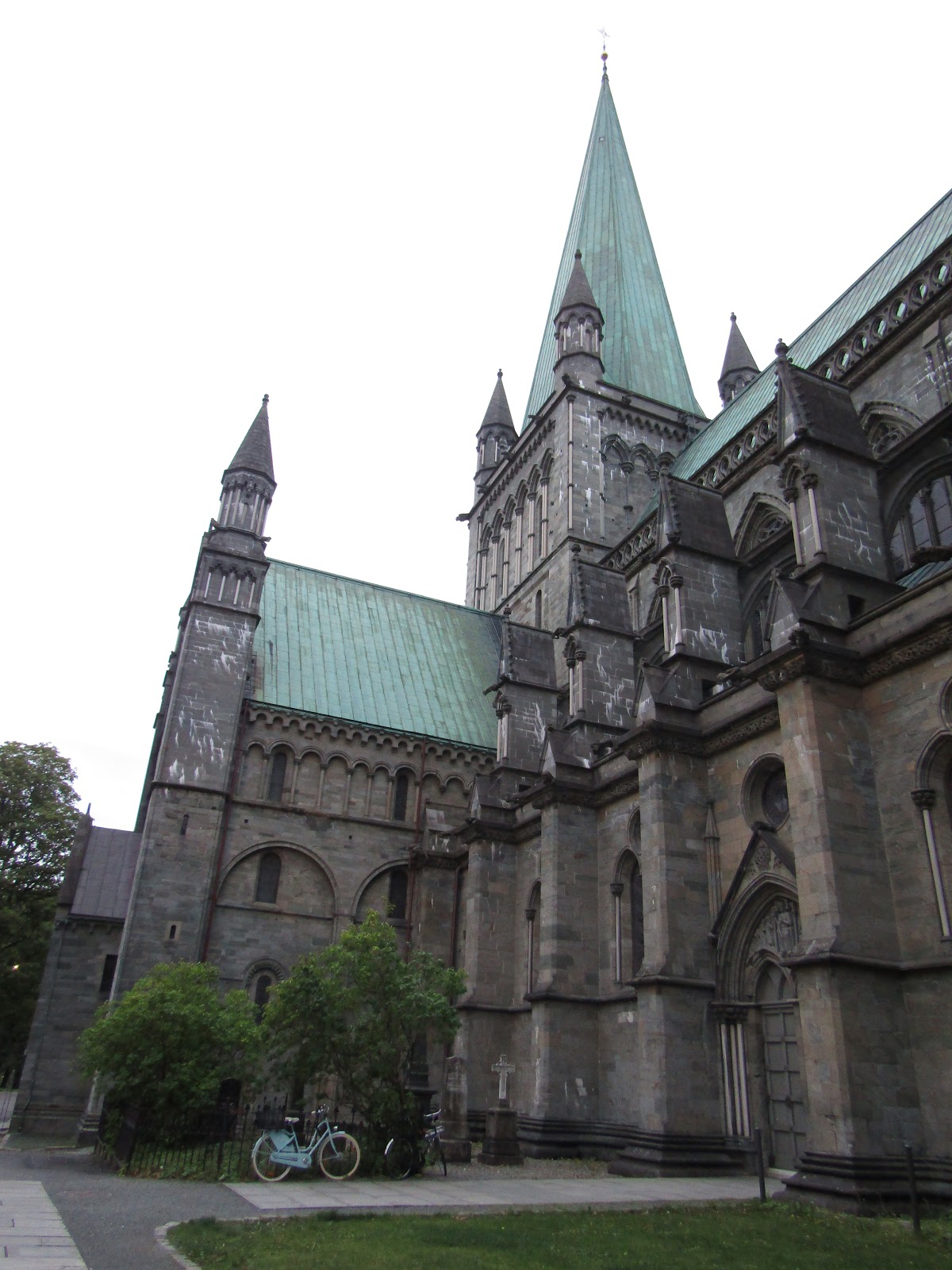
Nidarosdomen (Nidaros Cathedral).

Nidarosdomen is an iconic, easy-to-spot landmark in the city of Trondheim. It took 230 years to build the original church foundation, beginning in 1070 AD and finishing in 1300 AD.  The cathedral is built atop the grave of King Olav II of Norway, who is also known as St.Olaf, the patron saint of Norway. Today, the church is still in use and is the world's northernmost medieval church.

Detail on Nidarosdomen.

The church served the Catholic Archdiocese of Nidaros from 1152 AD till the reformation in 1152 AD. Today, the church is important for the Lutheran bishops of the Diocese of Nidaros.

The side of Nidarosdomen.

Over the years, the church has been damaged, especially from fires, and rebuilt time and time again. The last phase of rebuilding wrapped up in 2001. Today the church hosts regular services and tours, and is a popular pilgrim destination.

View of Gamle Bybro and Bakklandet houses along the Nidelva.

Across the Nidelva and Gamble Bybro lies the neighborhood of Bakklandet. In the 1960s, the homes and narrow streets were almost demolished to give way to a highway. Fortunately, plans changed with public resistance, leaving quaint old streets, buildings, and cafés.

Homes from Bakklandet along the Nidelva.

Outside of the Trøndelag Teater.

We didn't actually see the inside of Trøndelag Teater, but it was a pleasant sight to walk by in the morning. As it turns out, Trøndelag Teater is Scandinavia's oldest continually used theater first built in 1816. 

Kayakers on the Nidelva. 

While Trondheim may have a reputation of being a rainy city, we had near perfect weather when we were there and had a lovely time exploring the town. 
Tusen takk Trondheim!

Friday, September 21, 2018

Kristiansten Festning

A Fortress from the Past

Walking through the park surrounding Kristiansten Festning.

On Sunday afternoon, the sun was out and shining in Trondheim. We took advantage of the pleasant weather to do a bit of sightseeing.  Our first stop was to Kristiansten Festning (Kristiansten Fortress).

Near the fortress entrance looking down towards the city.

Kristiansten Festning lies on a large hill in the east side of Trondheim, and was built in 1681 to protect the city center from invaders. 

Welcome to Kristiansten Fortress.

Construction for the fortress completed in 1685, and saw its first main invasion by the Swedes in 1718. After an intense battle, the Swedes were forced to retreat back to Sweden, however many perished during the occupation and retreat due to the horrendous winter conditions.

Outer wall of the fortress.

During WWII, the fortress was used by the Nazis to execute Norwegians. However, after the war the tables were turned and a number of war criminals and traitors were executed on the site.

The defensive tower and canons lined up atop the fortress.

Today the fortress mainly consists of canons positioned along the edges, a restaurant, old stable area, and defense tower. There are also a few different levels and some tunnels to explore.

On the top floor of dojonen (the defensive tower)

Dojonen, or the defensive tower, is the present-day fortress museum.  Admission is free, and inside there are different historical displays and artifacts recovered from the site.  The tower has three floors accessible to the public by ladder. On every level canons guard the windows. The top floor had a low ceiling, but I was the perfect size to walk around without needing to duck. The wooden beams on the actual floors themselves were a bit sketchy in some places, so we didn't stay up top too long before heading back downstairs.

View of Trondheim from atop the fortress.

If you want to get a good view of Trondheim, then the fortress is the place to be! It's also fairly close to the city center, and easy to walk up to, making the views more than worth it.

Different levels within the fortress.

Though there aren't too many actual buildings standing atop the fortress, there is quite a lot of space along the grounds, and also a large park surrounding the fortress down below.

Art sculpture standing near the defensive tower.

There were a lot of interesting sculptures around the grounds of the fortress. Most were different humanoid figurines, but also a few dog sculptures.

Statue of a crying girl.

Honestly, the artwork was a bit dark and somber. Most figurines were kind of cowering or had their faces hidden, making them look slightly frightening and almost demonic.

Looking east over the fortress grounds.

Besides taking in the history and vantage point, the fortress is a great space to walk around, take in some fresh air, or even enjoy a picnic. 

Photo-op with Norwegian flag and cannons.

I had a lovely time visiting Kristiansten Festning and definitely would recommend stopping by it if you visit Trondheim!

A Climate Seminar in Trondheim

Activism. Awareness. Adventure.

Last weekend I attended a climate seminar in Trondheim, sponsored by Naturvernforbundet (Friends of the Earth) Norway. The seminar was for students from Bergen, Trondheim, Oslo, and couple of other cities in Norway who are part of Naturvernstudenten (Nature & Youth). 

The building known as "Hogwarts" on NTNU campus.

Klimaseminar for studenter
Trondheim is in the north, about seven hours away from Oslo by train. A group of about twenty students arrived in Trondheim from Oslo late on Friday and spent the night in a hostel. The next morning after breakfast we headed out to the Norwegian University of Science & Technology (NTNU) campus for the first day of the seminar.  We had a little trek across town, but it was easy to spot NTNU, because we just had to find the place that looked like "Hogwarts."

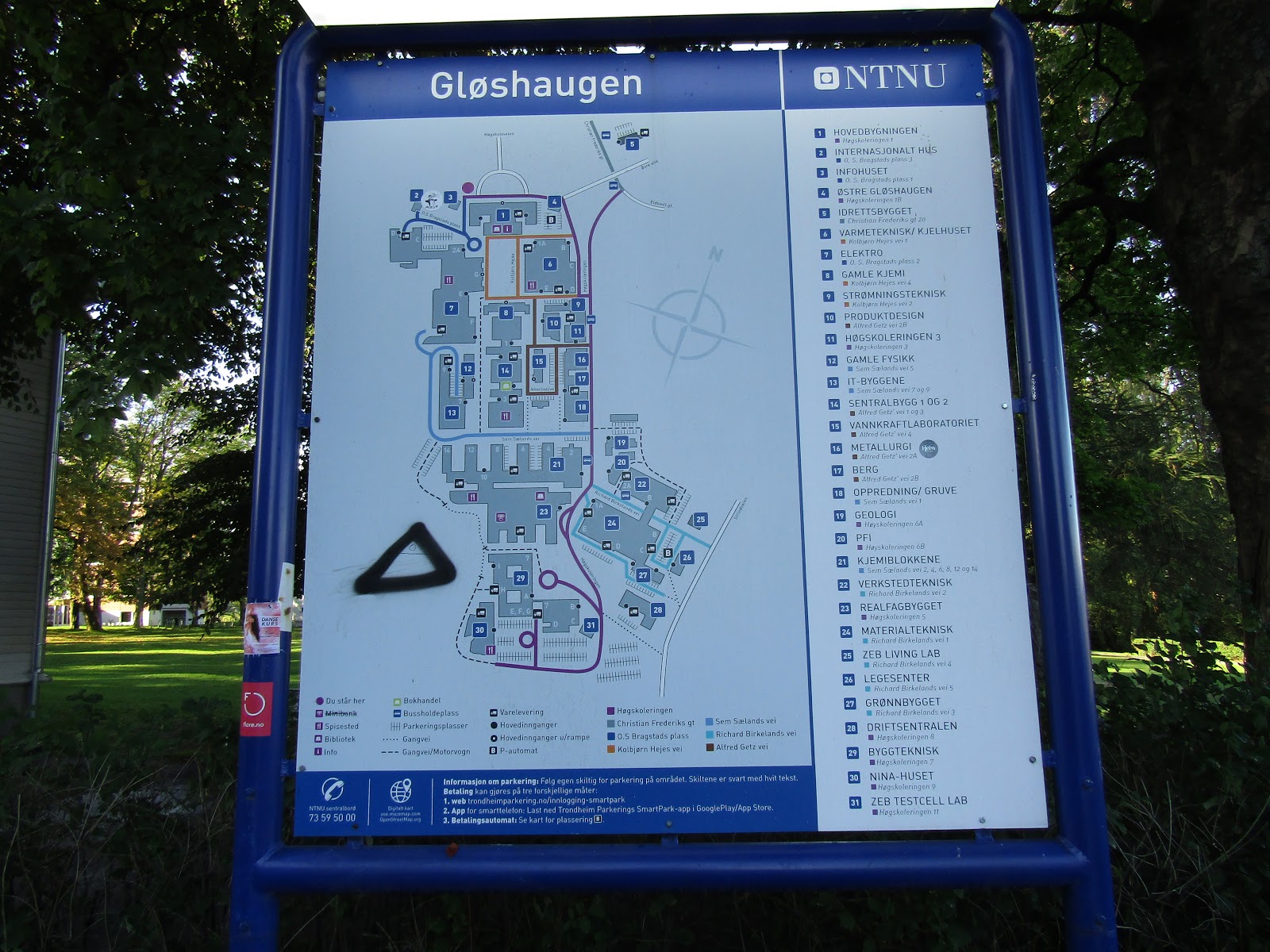
Map of the NTNU campus.

Finding the building where the seminar was being held was a little more difficult, and we ended up taking the long way around campus trying to find it. Fortunately, it was a beautiful day outside!

Audun Randen Johnson from Naturvernforbundet introducing the seminar.

Welcome to the seminar!
The climate seminar was a two-day event, with different presentations and activities aimed at educating and cultivating awareness, showing what is being done to protect the environment, and inspiring action. The first day, there were different guest lectures, a walking tour of Trondheim, and lunch & dinner. The second day, was more intimate, with a couple of presentations to see what local Nature & Youth groups are doing across Norway, discussions about how to facilitate communication and exchanges between the youth groups and the Friends of the Earth adult groups, and a trash pick-up on the NTNU campus.

Day 1 of the Climate Seminar.

From Arctic Drilling to Jellyfish & Marshes
The first day of the seminar, there were about thirty students from across Norway and several different guest speakers.  The presentations were about oil/gas and current/past lawsuits to protect against new oil exploration. Engineers without Borders, the Trondheim Kommune (city), and representatives from offshore wind and solar groups; presented about green technology and how renewable energy is the way of the future. Regenskogfondet (Rainforest Foundation Norway) discussed how climate defenders are under-threat around the globe. There was also a presentation about the importance of marshes, and the possibility of using Jellyfish slime to address micro-plastic pollution in the ocean.

Inside the building where Day 1 of the seminar was held.

English or Norwegian?
The climate seminar was supposed to be held in Norwegian with the exception of a couple of presentations in English, so they arranged a translator to help us. I felt a bit like an UN official using a headset to get the translations. However, there were about twelve international students in the meeting, so instead of having two of eight presentations in English, the numbers were actually flipped, so only two of eight were in Norwegian.
Only in Norway do the presenters see a group of foreign students and decide on the spot to speak in English instead. I think this says a lot about how Norwegians are flexible, friendly, and really care enough to accommodate us without notice.

Exploring the NTNU campus.

Impressions 
The time passed quickly because the lectures were very interesting. My favorite presentation was on the importance of marshes. Peat-land is one of the most vital carbon storage facilities, so when marshes get drained enormous amounts of the potent greenhouse gas, methane, are released. Draining marshes also leads to permanent land sinking. For example, some farmland in the UK has sunk over four meters since 1870. This has major implications because coupled with rising sea-levels from climate change, many areas are now below sea level, meaning there will be more flooding, loss of agricultural land, and other adverse problems. Two of the examples of areas where marshland has been drained are San Francisco in the U.S. and the Netherlands, which both continue sinking each year. I knew that the Netherlands was below sea level, but I didn't realize it was from the draining of marshland centuries ago, so I thought that was really interesting.

Last unit in class we talked about resource extraction and indigenous rights, so the Rainforest Foundation's presentation on climate defenders, reinforced a lot of what we learned. Climate defenders are human rights defenders, who fight for the right to organize, free speech, and to protect land rights, and the environment. Strikingly, the violence against defenders is increasing every year, with 207 reported deaths in 2017 alone. Wealthy corporations and officials often criminalize, repress, and threaten groups for prioritizing the livelihoods of indigenous groups, farmers, and ecological welfare above profits and exploitation.

One area I am particularly intrigued by is the use of plastic, especially with concern to plastic in the ocean. The project, Go Jelly, is testing how jellyfish slime can be used to filter micro-plastics in the sea. I have no idea who came up with the idea of using jellyfish slime as a bio-filter, but it could potentially be a huge solution to our pollution problems. You can learn more about the project here.

Approaching folkekjøkken (the People's Kitchen) on our walking tour.

Food & Sightseeing
For lunch at the seminar we had delicious falafel, baklava, and vegan chocolate cake. On the second day we also had delicious roasted eggplant sandwiches. The food came from Alibaba Falafel which is a business inspired by the food traditions of Syrian refugees. The idea for the food came from the People's Kitchen (folkekjøkken) in Trondheim, which every Tuesday cooks meals using ingredients from stores/restaurants that would otherwise be thrown away. Such a great idea and so much delicious food!

From the top of the hill looking down towards the bike elevator.

Say Goodbye to Biking Uphill! 
Have you ever seen a large hill and felt the horror of having to bike to the top? Fear no more, Trondheim has its own bicycle elevator!

Riders taking the bicycle elevator up the hill.

Personally, I think this bicycle elevator would be more difficult than simply riding up the hill. At the bottom you press a few buttons and align your foot at the end of a metal 'box.' A small metal block then comes out of the box and should catch under your right foot, propelling you and your bike up the hill. From my observations, it seems a bit challenging to get the metal block to stay under your foot. It's also a bit of a balancing act, and if you fall off the lift, the block immediately disappears into the ground.

Another rider using the bicycle elevator up the hill.

The bike elevator was part of a Trondheim city initiative to promote bike use over cars. Unfortunately for cyclists, this is the only bike lift in the city.

Gathering to learn about tiny homes.

An Alternative Neighborhood
On our walking tour of the city we also went and visited some tiny homes. The homes were hand-built, mobile, eco-friendly, and actually quite nice and spacious inside.

Garden near the tiny homes.

The city-tour wasn't your typical tourist trip. We got to see different places where green tech and living has been promoted in Trondheim. It was nice to get to see some of the unique locales, one normally wouldn't know about or get to see otherwise.

More tiny homes along the tour.

Climate Seminar Success
Overall, the climate seminar was a lot of fun! I got to meet a lot of like-minded students from across Norway, taste delicious food, enjoy exciting presentations, & visit a new city.

Photo of climate seminar participants during tour courtesy of Naturvernforbundet Norway.

Tusen Takk Naturvernforbundet!
Many thanks to Naturnvernforbundet Norway for an incredible weekend in Trondheim! I had such a blast and am really looking forward to getting more involved in Youth in Nature.  If you're interested in learning more about the organization, or would like to check out some of the presentations from the conference please click here. Tusen Takk (Thank you)!

Thursday, September 13, 2018

Tvergastein: Interdisciplinary Journal of the Environment

An Environmental Journal? 
In addition to my studies, I am on the board of an academic interdisciplinary journal called, Tvergastein, which is based at the University of Oslo's Centre for Environment and Development (SUM). Tvergastein is named after the location of SUM founder and inspirational figure, Arne Naess' cabin retreat.  We publish two journals each year with various articles relation to different themes. Our next edition, coming out this January, is focused on Peace & Environment.

Now Accepting Submissions!
Currently we're taking submissions for our upcoming issue on Peace & Environment.  Everyone interested is encouraged to submit a piece! We want to hear your own interpretations, experiences, or research on the topic of conflict and/or peace, & the environment.

- Submissions can be op-ed or academic style
- Deadline is October 1st, 2018

Go to www.tvergastein.com to learn more about the journal & submission requirements! 

Also, check us out at:

Poster I designed for the journal; photo from Lahti, Finland.

Please email any questions or submissions to tvergastein.journal@gmail.com. If we do publish a piece, we'll send you a copy of the journal abroad too! 

We look forward to reading your submissions!