Activism. Awareness. Adventure.
Last weekend I attended a climate seminar in Trondheim, sponsored by Naturvernforbundet (Friends of the Earth) Norway. The seminar was for students from Bergen, Trondheim, Oslo, and couple of other cities in Norway who are part of Naturvernstudenten (Nature & Youth).

The building known as "Hogwarts" on NTNU campus.
Klimaseminar for studenter
Trondheim is in the north, about seven hours away from Oslo by train. A group of about twenty students arrived in Trondheim from Oslo late on Friday and spent the night in a hostel. The next morning after breakfast we headed out to the Norwegian University of Science & Technology (NTNU) campus for the first day of the seminar. We had a little trek across town, but it was easy to spot NTNU, because we just had to find the place that looked like "Hogwarts."
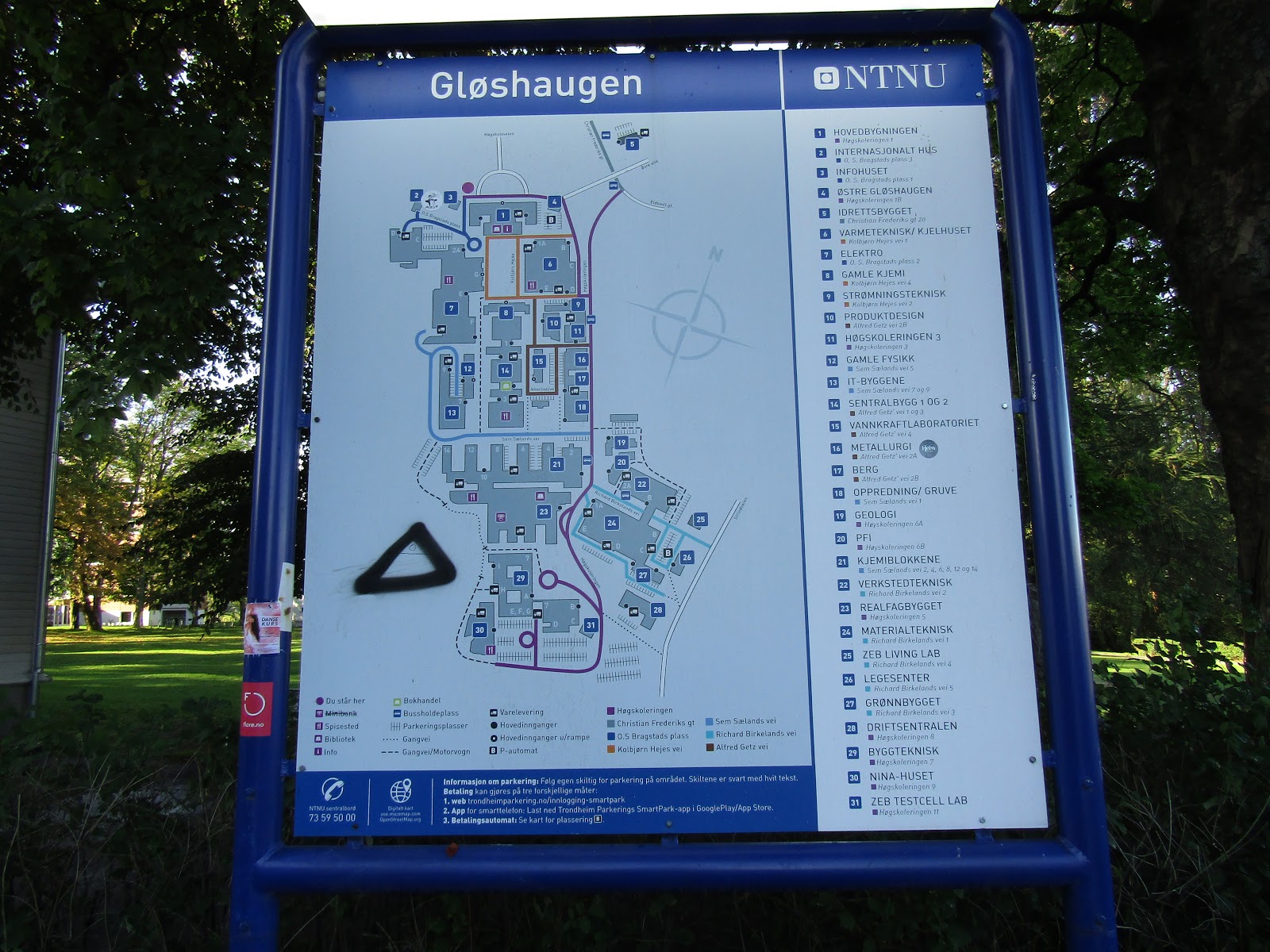
Map of the NTNU campus.
Finding the building where the seminar was being held was a little more difficult, and we ended up taking the long way around campus trying to find it. Fortunately, it was a beautiful day outside!

Audun Randen Johnson from Naturvernforbundet introducing the seminar.
Welcome to the seminar!
The climate seminar was a two-day event, with different presentations and activities aimed at educating and cultivating awareness, showing what is being done to protect the environment, and inspiring action. The first day, there were different guest lectures, a walking tour of Trondheim, and lunch & dinner. The second day, was more intimate, with a couple of presentations to see what local Nature & Youth groups are doing across Norway, discussions about how to facilitate communication and exchanges between the youth groups and the Friends of the Earth adult groups, and a trash pick-up on the NTNU campus.

Day 1 of the Climate Seminar.
From Arctic Drilling to Jellyfish & Marshes
The first day of the seminar, there were about thirty students from across Norway and several different guest speakers. The presentations were about oil/gas and current/past lawsuits to protect against new oil exploration. Engineers without Borders, the Trondheim Kommune (city), and representatives from offshore wind and solar groups; presented about green technology and how renewable energy is the way of the future. Regenskogfondet (Rainforest Foundation Norway) discussed how climate defenders are under-threat around the globe. There was also a presentation about the importance of marshes, and the possibility of using Jellyfish slime to address micro-plastic pollution in the ocean.

Inside the building where Day 1 of the seminar was held.
English or Norwegian?
The climate seminar was supposed to be held in Norwegian with the exception of a couple of presentations in English, so they arranged a translator to help us. I felt a bit like an UN official using a headset to get the translations. However, there were about twelve international students in the meeting, so instead of having two of eight presentations in English, the numbers were actually flipped, so only two of eight were in Norwegian.
Only in Norway do the presenters see a group of foreign students and decide on the spot to speak in English instead. I think this says a lot about how Norwegians are flexible, friendly, and really care enough to accommodate us without notice.

Exploring the NTNU campus.
The time passed quickly because the lectures were very interesting. My favorite presentation was on the importance of marshes. Peat-land is one of the most vital carbon storage facilities, so when marshes get drained enormous amounts of the potent greenhouse gas, methane, are released. Draining marshes also leads to permanent land sinking. For example, some farmland in the UK has sunk over four meters since 1870. This has major implications because coupled with rising sea-levels from climate change, many areas are now below sea level, meaning there will be more flooding, loss of agricultural land, and other adverse problems. Two of the examples of areas where marshland has been drained are San Francisco in the U.S. and the Netherlands, which both continue sinking each year. I knew that the Netherlands was below sea level, but I didn't realize it was from the draining of marshland centuries ago, so I thought that was really interesting.
Last unit in class we talked about resource extraction and indigenous rights, so the Rainforest Foundation's presentation on climate defenders, reinforced a lot of what we learned. Climate defenders are human rights defenders, who fight for the right to organize, free speech, and to protect land rights, and the environment. Strikingly, the violence against defenders is increasing every year, with 207 reported deaths in 2017 alone. Wealthy corporations and officials often criminalize, repress, and threaten groups for prioritizing the livelihoods of indigenous groups, farmers, and ecological welfare above profits and exploitation.
One area I am particularly intrigued by is the use of plastic, especially with concern to plastic in the ocean. The project, Go Jelly, is testing how jellyfish slime can be used to filter micro-plastics in the sea. I have no idea who came up with the idea of using jellyfish slime as a bio-filter, but it could potentially be a huge solution to our pollution problems. You can learn more about the project here.

Approaching folkekjøkken (the People's Kitchen) on our walking tour.
For lunch at the seminar we had delicious falafel, baklava, and vegan chocolate cake. On the second day we also had delicious roasted eggplant sandwiches. The food came from Alibaba Falafel which is a business inspired by the food traditions of Syrian refugees. The idea for the food came from the People's Kitchen (folkekjøkken) in Trondheim, which every Tuesday cooks meals using ingredients from stores/restaurants that would otherwise be thrown away. Such a great idea and so much delicious food!

From the top of the hill looking down towards the bike elevator.
Say Goodbye to Biking Uphill!
Have you ever seen a large hill and felt the horror of having to bike to the top? Fear no more, Trondheim has its own bicycle elevator!

Riders taking the bicycle elevator up the hill.
Personally, I think this bicycle elevator would be more difficult than simply riding up the hill. At the bottom you press a few buttons and align your foot at the end of a metal 'box.' A small metal block then comes out of the box and should catch under your right foot, propelling you and your bike up the hill. From my observations, it seems a bit challenging to get the metal block to stay under your foot. It's also a bit of a balancing act, and if you fall off the lift, the block immediately disappears into the ground.

Another rider using the bicycle elevator up the hill.

Gathering to learn about tiny homes.
An Alternative Neighborhood
On our walking tour of the city we also went and visited some tiny homes. The homes were hand-built, mobile, eco-friendly, and actually quite nice and spacious inside.

Garden near the tiny homes.

More tiny homes along the tour.
Climate Seminar SuccessOverall, the climate seminar was a lot of fun! I got to meet a lot of like-minded students from across Norway, taste delicious food, enjoy exciting presentations, & visit a new city.

Photo of climate seminar participants during tour courtesy of Naturvernforbundet Norway.
Tusen Takk Naturvernforbundet!
Many thanks to Naturnvernforbundet Norway for an incredible weekend in Trondheim! I had such a blast and am really looking forward to getting more involved in Youth in Nature. If you're interested in learning more about the organization, or would like to check out some of the presentations from the conference please click here. Tusen Takk (Thank you)!


